How to Choose the Right Livestock Injection?
Choosing the right Livestock Injection is a clinical decision, not a purchasing shortcut. A product suitable for a mature dairy cow may be unsuitable for a newborn lamb or growing pig. Species, body weight, diagnosis, injection route, tissue site, and withdrawal instructions all affect safety and performance. The Food and Agriculture Organization’s 2023 State of Food and Agriculture connects livestock decisions with wider food-system, health, and environmental outcomes. WOAH standards also emphasize responsible veterinary medicine use, traceability, and strict compliance with product labels. These sources support one practical principle: selection must begin with the animal and the diagnosis.
A reliable choice starts with a licensed veterinarian, an accurate assessment, and a clearly documented treatment plan. Check the active ingredient, concentration, expiration date, storage temperature, and approved species. A cold-chain failure can quietly reduce vaccine effectiveness. An incorrect needle length can damage tissue or deliver medicine into the wrong layer. The FDA’s 2023 Summary Report recorded a 38% decline in domestic sales and distribution of medically important antimicrobials for food-producing animals compared with 2015. This trend reflects stronger antimicrobial stewardship, although sales data cannot explain every farm-level decision. The report is useful, but it is not a treatment guide. Even experienced producers can overlook label differences between similar-looking bottles. Good selection therefore combines professional judgment, current regulatory guidance, farm records, and careful observation after injection. The best decision is not always the fastest one. Safety deserves another check.
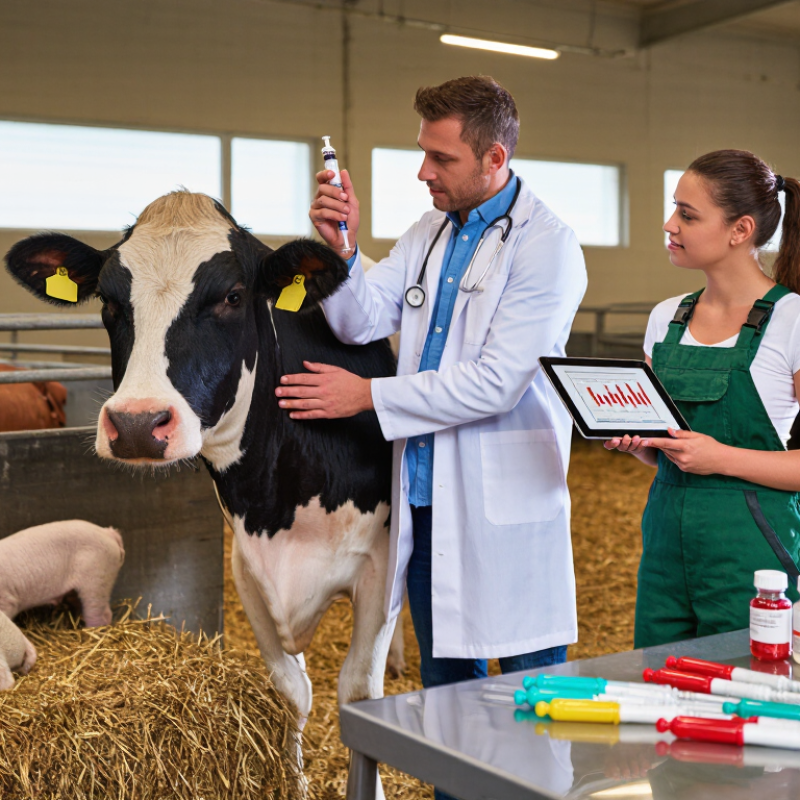
Define the Case: Species, weight, diagnosis, and FDA-approved indication
How to Choose the Right Livestock Injection?
Choosing a livestock injection begins with defining the case, not opening a medicine cabinet. Identify the species, because cattle, sheep, pigs, and goats may process medicines differently. Record the animal’s accurate weight, preferably using a scale rather than visual guessing. Small errors can matter.
Describe the diagnosis clearly. A cough, swollen joint, or fever may have several causes. A veterinarian should examine the animal and confirm whether an injection is appropriate. The product must have an FDA-approved indication for that species, condition, and route of administration. Check the label carefully. It should specify dosage, injection site, frequency, and withdrawal periods for meat or milk.
Details matter here.
In practice, write the case information before selecting a product: “52-kilogram lamb, fever, reduced appetite, suspected bacterial pneumonia.” That note helps prevent a rushed decision. Do not assume a medicine approved for one species is suitable for another. Extra-label use may require professional oversight and lawful direction. Keep treatment records, including the lot number, date, dose, and person administering it.
A common mistake is trusting appearance instead of diagnosis. I have seen weight estimates, old labels, and incomplete records create avoidable uncertainty. Recheck the animal, the label, and the calculation. If any detail conflicts, pause and ask a licensed veterinarian. Reliable treatment starts with a defined case and accurate information.
Compare Active Ingredients: Spectrum, resistance risk, and WOAH stewardship criteria
How to Choose the Right Livestock Injection?
Choosing a livestock injection starts with its active ingredient, not its package color. Read the label carefully. Identify the target bacteria, parasite, or disease process. A narrow-spectrum ingredient may treat the confirmed problem while protecting beneficial microbes. A broad-spectrum option can be useful when diagnosis is uncertain, but it may increase selection pressure. Wider coverage is not always better.
Resistance risk deserves close attention. Check local treatment records, laboratory results, and, when practical, susceptibility testing. Avoid repeating an ingredient merely because it worked last season. That habit is convenient, but it can quietly reduce future effectiveness. Dose accuracy matters too. A poorly calibrated syringe can produce underdosing, treatment failure, and stronger resistance pressure. I have seen clean-looking records hide inconsistent injection volumes. Records need honest review.
WOAH stewardship principles support veterinary oversight, clear diagnosis, correct dosing, and responsible antimicrobial use. Select the narrowest effective spectrum when evidence allows. Reserve higher-priority antimicrobial classes for situations where alternatives are unsuitable and professional assessment supports their use. Follow approved routes, withdrawal periods, storage instructions, and animal welfare requirements. Never mix products unless compatibility is confirmed. Reassess animals that do not improve within the expected timeframe. Sometimes the first choice is wrong. That possibility should remain visible in every treatment plan.
Calculate the Dose: Apply the label’s mg/kg rate and injection volume
How to Choose the Right Livestock Injection?
Calculate the dose before preparing any syringe. Read the current product label carefully. It should state the dose in milligrams per kilogram, or mg/kg. Weigh the animal whenever possible. Guessing body weight can create a serious dosing error. Small errors matter.
Use this calculation: required milligrams equal body weight multiplied by the labeled mg/kg rate. Then calculate injection volume by dividing required milligrams by the product concentration in mg/mL. For example, a 500-kilogram animal prescribed 10 mg/kg needs 5,000 milligrams. With a 100 mg/mL concentration, the volume is 50 mL. This example is for calculation practice only. Never copy the dose without checking the specific label.
Check the permitted injection route and the maximum volume per site. A large volume may need several sites, but only when the label or veterinarian allows it. Use a clean, correctly sized syringe and record the animal’s weight, dose, time, route, and injection sites. Units deserve attention. Milligrams and milliliters are not interchangeable. I have found that writing the calculation on paper reduces rushed mistakes, although it does not replace professional judgment. If the label seems unclear, pause and ask a licensed veterinarian. Product concentration, animal species, age, health status, and withdrawal requirements can change the correct approach. Recheck the arithmetic before the needle is used.
How to Choose the Right Livestock Injection? - Calculate the Dose: Apply the label’s mg/kg rate and injection volume | Species | Animal Weight | Label Rate
(mg/kg) | Product Concentration
(mg/mL) | Total Active Ingredient Required
(mg) | Calculated Injection Volume
(mL) | Calculation | Practical Check |
| Core formulas: Total dose (mg) = body weight (kg) × label rate (mg/kg); Injection volume (mL) = total dose (mg) ÷ product concentration (mg/mL). |
| Beef cattle | 450 kg | 10 mg/kg | 200 mg/mL | 4,500 mg | 22.5 mL | 450 × 10 = 4,500 mg
4,500 ÷ 200 = 22.5 mL | Confirm the approved route, maximum volume per injection site, withdrawal period, and whether the calculated volume must be divided among sites. |
| Growing swine | 80 kg | 15 mg/kg | 100 mg/mL | 1,200 mg | 12.0 mL | 80 × 15 = 1,200 mg
1,200 ÷ 100 = 12.0 mL | Use a properly graduated syringe and check whether the label specifies a maximum volume at one injection site. |
| Adult sheep | 60 kg | 5 mg/kg | 100 mg/mL | 300 mg | 3.0 mL | 60 × 5 = 300 mg
300 ÷ 100 = 3.0 mL | Verify the label’s species approval and route. Do not substitute a sheep dose for a goat dose without veterinary direction. |
| Adult goats | 40 kg | 8 mg/kg | 50 mg/mL | 320 mg | 6.4 mL | 40 × 8 = 320 mg
320 ÷ 50 = 6.4 mL | Check whether the product is specifically labeled for goats; species differences can affect legal use and withdrawal requirements. |
| Young cattle | 120 kg | 20 mg/kg | 100 mg/mL | 2,400 mg | 24.0 mL | 120 × 20 = 2,400 mg
2,400 ÷ 100 = 24.0 mL | A large calculated volume may need to be divided into multiple injection sites if the approved label requires it. |
| Small pig | 25 kg | 10 mg/kg | 50 mg/mL | 250 mg | 5.0 mL | 25 × 10 = 250 mg
250 ÷ 50 = 5.0 mL | Record the animal identification, weight estimate, product concentration, dose, route, and administration date. |
| Important: These are generic calculation examples using hypothetical label rates and concentrations for training purposes, not treatment instructions. Always follow the current approved product label and veterinary guidance. Confirm the animal’s actual or carefully estimated weight, concentration, route, injection-site limits, storage requirements, contraindications, and applicable meat or milk withdrawal period before administration. |