
How to Source Bovine Collagen Peptide in 2026? begins with a practical question: what does “quality” actually mean? The global collagen market reached approximately USD 9.76 billion in 2023, according to Grand View Research, which forecasts continued growth through 2030. MarketsandMarkets also identifies food, beverages, nutrition, and cosmetics as major collagen application areas. These figures show demand. They do not guarantee dependable supply.
Bovine Collagen Peptide should be evaluated through documented evidence, not attractive sales language. Buyers need the cattle origin, processing country, hydrolysis method, average molecular-weight distribution, protein content, moisture, ash, and amino-acid profile. Hydroxyproline results can help verify collagen identity. A recent certificate of analysis matters more than an old brochure. Batch traceability matters more than a low first quotation. Small details reveal large risks.
Professor Keith Baar, a tendon-biology researcher at the University of California, Davis, has described collagen as “the most abundant protein in the body.” His observation explains why sourcing decisions require scientific discipline. However, suppliers should not turn this fact into unsupported health promises. Regulatory status, allergen controls, microbiological testing, heavy-metal limits, and halal or kosher documentation must match the destination market. Ask for independent laboratory verification.
There is no perfect supplier.
In practice, I would compare three to five manufacturers using the same specification sheet. I would inspect sample solubility in cold water, odor, color, packaging integrity, and shipping conditions. One uncomfortable lesson remains: the cheapest offer may become the most expensive after failed batches, delayed customs clearance, or inconsistent sensory performance. Reliable sourcing is slower, but it is easier to defend.
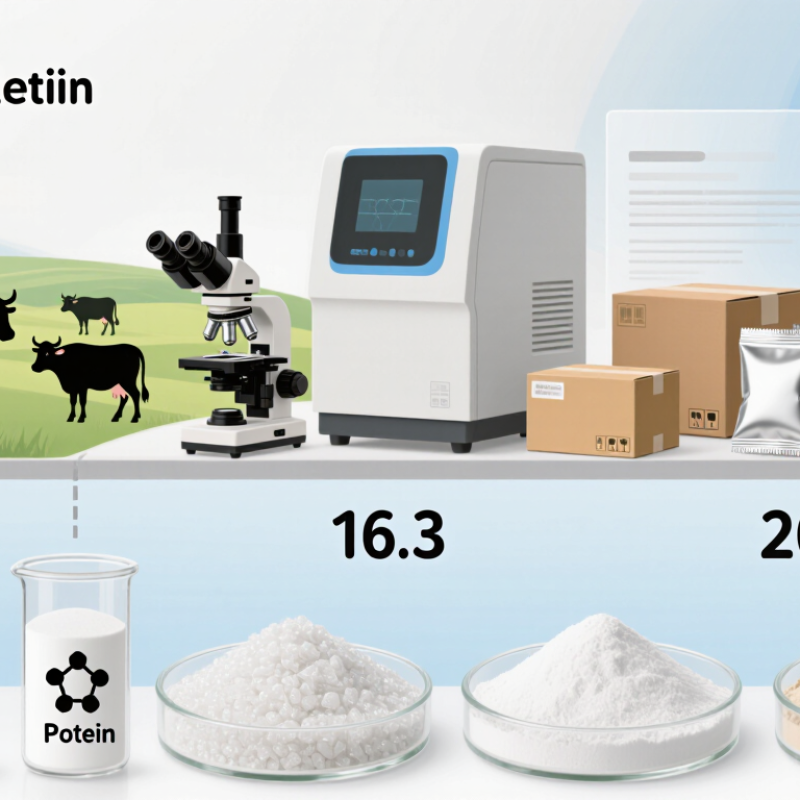
Bovine collagen peptide is collagen protein broken into smaller chains through controlled enzymatic hydrolysis. It usually comes from cleaned bovine hides or bones. The process improves dispersibility and makes the ingredient easier to use in food and nutrition products. Bovine collagen mainly contains Type I collagen, with smaller amounts of Type III collagen. Its amino acid profile is rich in glycine, proline, and hydroxyproline. It is not a complete protein source because it lacks sufficient tryptophan.
The main applications include powdered supplements, ready-to-mix drinks, protein bars, gummies, and functional foods. Manufacturers also use it in selected cosmetic formulations, especially products designed for skin-conditioning purposes. Application decisions depend on solubility, odor, particle size, thermal stability, and moisture control. In 2026, sourcing should include a clear origin statement, batch traceability, microbiological testing, heavy metal results, and hydroxyproline or protein assay data. A low price can hide weak documentation. That matters.
Tips: Request a current certificate of analysis for every production batch. Check whether the raw material comes from inspected facilities and follows applicable food-safety requirements. Ask for allergen, bovine-origin, and processing statements. Compare dissolution tests in your actual formula, not only in laboratory water. I would also review flavor after storage. It can change. Some buyers focus too heavily on protein percentage, while overlooking odor, packaging integrity, and supplier response time. That is an easy mistake to reconsider.
Reliable sourcing begins with traceability, not a polished specification sheet. Request records showing the cattle’s origin, tissue source, processing site, and production dates. The supplier should provide a current certificate of analysis for every batch. Check peptide content, moisture, ash, molecular-weight distribution, microbiological limits, heavy metals, and veterinary-residue testing. Test results should come from a qualified laboratory, not only an internal spreadsheet.
Safety needs practical verification. Ask whether the material follows documented GMP and HACCP controls. Review evidence for bovine spongiform encephalopathy controls, cleaning validation, allergen management, and foreign-material prevention. Retained samples can help resolve quality disputes. They matter. A factory audit should examine storage temperature, water quality, calibration records, and complaint handling. One weakness remains common: buyers sometimes accept old certificates because the numbers look familiar. That is not strong evidence.
Regulatory review depends on the destination market and product category. Confirm whether the peptide is intended for food, supplements, or cosmetics. Check permitted ingredients, labeling rules, allergen statements, animal-origin declarations, and claim restrictions with current official guidance. Halal or kosher certification may also matter for the target market. Do not rely on a supplier’s claim that approval is “global.” It rarely is. A written quality agreement should define specifications, change notification, deviation reporting, and recall responsibilities. Before signing, compare at least two production lots and evaluate taste, odor, solubility, and stability under realistic storage conditions. Ones that pass only on paper deserve another review.
In 2026, sourcing bovine collagen peptide requires more than comparing price per kilogram. A reliable evaluation begins with raw material control. Ask whether hides or bones have documented origins, veterinary oversight, and batch-level traceability. The supplier should explain storage temperatures, cleaning steps, and transport records. Small details matter. A clear certificate of analysis should include protein content, moisture, ash, microbiological results, heavy metals, and molecular-weight distribution. Do not accept a generic certificate copied across batches.
Manufacturing methods can change performance. Acid or alkaline pretreatment may influence collagen yield and processing time. Enzymatic hydrolysis usually offers tighter control over peptide size, but enzyme selection and reaction conditions require technical evidence. Review the hydrolysis profile, filtration system, concentration stage, and spray-drying settings. Then compare solubility in cold water, odor, color, and stability after storage. A low molecular-weight result is not automatically better. Your application decides the useful range.
When comparing suppliers, request recent production samples and test them under your own formulation conditions. Check whether the supplier supports pilot trials, deviation reports, and corrective actions. An on-site or independent audit can reveal weak sanitation practices that documents miss. No supplier is perfect. I have seen impressive specifications fail during scale-up. For that reason, compare three batches, not one. Consider lead time, minimum order quantity, packaging protection, and communication quality alongside laboratory data. A dependable partner can explain failures without hiding them.
| Supplier Category | Typical Raw Material | Primary Manufacturing Method | Typical Peptide Profile | Typical Protein Content | Key Advantages | Main Limitations | Documents to Request | Best Fit |
|---|---|---|---|---|---|---|---|---|
| Integrated collagen manufacturer | Bovine hides, split hides, or bones sourced from controlled slaughter channels | Cleaning, trimming, demineralization when required, acid or alkaline pretreatment, enzymatic hydrolysis, filtration, concentration, drying | Usually hydrolyzed peptides in the approximately 1,000–5,000 dalton range; distribution varies by enzyme and process time | Commonly about 90% or higher on a dry basis, depending on the agreed specification | Better traceability, stronger control of processing parameters, and more consistent batch-to-batch quality | Higher minimum order quantities and longer qualification timelines may apply | Certificate of analysis, allergen statement, origin and traceability records, microbiological results, heavy-metal report, veterinary or food-safety certificates, stability data | Long-term contracts, regulated food or supplement production, and high-volume applications |
| Specialty peptide producer | Pre-produced bovine gelatin or collagen prepared from hides or bones | Controlled enzymatic hydrolysis followed by membrane separation, spray drying, and optional agglomeration | Often supplied with a defined average molecular-weight target, such as below 3,000 daltons; exact distribution should be verified analytically | Typically 90–95% protein, subject to moisture, ash, and test method | Good solubility, neutral flavor options, and the ability to tailor particle size or molecular-weight distribution | Less control over the original raw-material chain if the starting gelatin is externally purchased | Raw-material declaration, hydrolysis process summary, molecular-weight test method, solubility data, sensory profile, batch records, and quality certifications | Powdered beverages, nutrition products, ready-to-mix formulas, and products requiring rapid dissolution |
| Gelatin-to-peptide processor | Food-grade bovine gelatin derived mainly from hides or bones | Thermal gelatin extraction followed by enzymatic breakdown of gelatin molecules into shorter peptides | Broad peptide distribution; commonly optimized for high dispersibility rather than one narrow molecular-weight fraction | Often around 85–95%, depending on moisture and mineral content | Established raw-material pathway, scalable production, and generally competitive cost | Potential variation in taste, color, ash, and peptide distribution between gelatin inputs | Gelatin origin statement, hydrolysis conditions, ash and moisture results, microbiological certificate, residual-solvent statement, and sensory specifications | Cost-sensitive supplements and general-purpose collagen peptide formulas |
| Bone-based collagen processor | Bovine bones and ossein after removal of fat and mineral components | Degreasing, demineralization, collagen extraction, enzymatic hydrolysis, purification, and drying | Hydrolyzed Type I collagen peptides; molecular-weight distribution depends on enzyme selection and hydrolysis duration | Usually specified at approximately 90% or higher protein, with ash requiring close review | Can provide efficient use of bovine by-products and a strong sustainability narrative | Residual mineral content, ash level, and traceability need particularly careful verification | Ash certificate, calcium and phosphorus results, demineralization records, origin documentation, contaminant testing, and BSE/TSE statement | Applications where by-product utilization, mineral control, and supply-chain transparency are priorities |
| Hide-based collagen processor | Bovine hide splits or trimmed hide pieces | Washing, liming or alternative pretreatment, neutralization, collagen extraction, enzymatic hydrolysis, clarification, and spray drying | Predominantly Type I collagen peptides with a profile determined by pretreatment severity and enzyme selection | Commonly around 90–95% on a dry basis when sufficiently purified | Widely available raw material and potentially lower mineral content than bone-derived material | Pretreatment chemicals, odor, color, and environmental controls must be reviewed carefully | Chemical-residue statement, wastewater-control information, traceability records, color and odor specifications, microbiological data, and BSE/TSE statement | Neutral-flavor powders, capsules, tablets, and high-volume food applications |
| Custom-formulation supplier | Qualified bovine hide- or bone-derived collagen peptide, sometimes blended with permitted carriers or flavor systems | Supplier-managed peptide sourcing followed by blending, flavoring, agglomeration, sachet filling, or capsule production | Depends on the selected peptide input; the finished blend may not represent a single molecular-weight profile | Finished-product protein level varies according to the formula and inclusion rate | Shorter product-development path, flexible pack sizes, and support with formulation and regulatory labeling | Reduced visibility of the upstream manufacturer unless full supply-chain disclosure is required | Full ingredient list, upstream manufacturer details, finished-product certificate of analysis, allergen statement, packaging specification, shelf-life data, and regulatory declarations | Private-label products, pilot launches, and buyers seeking finished consumer-ready formats |
| Method | Process Description | Typical Output | Solubility | Process Control Priority | Sourcing Consideration |
|---|---|---|---|---|---|
| Acid-soluble collagen extraction | Acid is used to solubilize collagen before purification; this is generally an extraction route rather than the final peptide-production step | Higher-molecular-weight collagen or gelatin intermediate | Good under suitable pH and temperature conditions; final peptide solubility depends on subsequent hydrolysis | pH, temperature, extraction time, acid neutralization, and residual ash | Confirm whether the material is collagen, gelatin, or fully hydrolyzed collagen peptide before purchase |
| Pepsin-assisted extraction | Pepsin selectively removes some non-helical terminal regions during collagen extraction | More soluble collagen intermediate with reduced non-helical terminal sequences | Generally improved extraction performance; final instant solubility still depends on hydrolysis and drying | Enzyme activity, pH, temperature, reaction time, and enzyme deactivation | Ask whether pepsin is used only during extraction and whether the finished product is subsequently hydrolyzed |
| Enzymatic hydrolysis | Food-grade proteases break collagen or gelatin into shorter peptides under controlled conditions | Hydrolyzed bovine collagen peptide, commonly designed for rapid dissolution and low viscosity | Usually readily soluble in cold or warm water, depending on peptide size and drying conditions | Enzyme selection, degree of hydrolysis, reaction endpoint, filtration, and spray-drying temperature | Request molecular-weight distribution and degree-of-hydrolysis data instead of relying only on the term “hydrolyzed” |
| Membrane fractionation | Ultrafiltration or related membrane operations separate peptide fractions by size after hydrolysis | More controlled molecular-weight distribution and reduced levels of large peptides | Typically high, although concentration and drying can affect reconstitution performance | Membrane cut-off, flux, fouling control, recovery rate, and cleaning validation | Useful when a specification requires a defined peptide-size range or consistent sensory performance |
| Spray drying and agglomeration | Liquid peptide concentrate is dried into powder; agglomeration may improve flowability and instant dispersion | Free-flowing powder, with optional instantized particle structure | Usually good; agglomerated grades often disperse faster than fine, non-agglomerated powders | Inlet and outlet temperatures, moisture, water activity, bulk density, and particle-size distribution | Compare moisture, water activity, bulk density, dispersibility time, and packaging protection before approval |
Pricing should begin with specifications, not the lowest quotation. Ask for the peptide grade, protein content, packaging, minimum order quantity, and delivery terms. Compare landed cost, including freight, duties, testing, and storage. A cheap offer may become expensive after repeated retesting or delayed shipments. Request a written price-validity period because raw material and transport costs can change quickly. Keep an uncomfortable question in the discussion: what is missing from this quote?
Certification documents need careful review. Check whether the supplier maintains GMP, HACCP, ISO 22000, halal, or kosher certification for the relevant facility. The certificate holder, site address, scope, and expiry date should match the actual production location. For bovine materials, request traceability records and suitable BSE/TSE controls. A certificate alone is not proof of every batch.
Testing should include identity, protein content, moisture, microbiological limits, heavy metals, and the declared molecular-weight range. Ask for recent batch-specific certificates of analysis, not only a standard template. Independent laboratory verification can expose inconsistencies. It costs more, sometimes. Supply capacity also requires evidence. Review production lead times, monthly capacity, safety stock, backup raw-material sources, and past delivery performance. A supplier may promise capacity during a sales call, but production records tell a different story. Avoid relying on one successful sample; a second or third batch can reveal variation.
How to Source Bovine Collagen Peptide in 2026?
Sourcing should begin with samples, not price discussions. Request three production lots from the same bovine collagen peptide specification. Test solubility, odor, moisture, protein content, molecular weight distribution, microbiological limits, and heavy metals. Ask for a complete certificate of analysis and bovine-origin traceability. Grand View Research valued the global collagen market at approximately USD 10.15 billion in 2023, with projected growth near 9.6% annually through 2030. That growth increases competition, but it can also hide inconsistent quality. A sample can perform well while routine batches disappoint. This remains an uncomfortable possibility.
Tips: Record sample weight, mixing temperature, dissolution time, and final appearance. Keep sealed retention samples. Compare laboratory results with the supplier’s COA before approval.
Contracts should define the exact specification, approved test methods, packaging, shelf life, Incoterms, delivery windows, and change-notification periods. Include lot-level traceability and corrective-action requirements. For logistics, use moisture-resistant inner bags, intact pallets, and documented humidity controls. Collagen peptide absorbs moisture quickly. A damaged liner may create caking before arrival. Confirm customs documents, product classification, insurance, and temperature requirements before booking freight. The International Trade Centre and UN Comtrade data can help benchmark trade flows, but shipment volume does not prove supplier reliability.
Supplier management needs measurable reviews. Track on-time delivery, complaint rates, test deviations, response speed, and CAPA closure. Audit records annually, or after repeated failures. Forecasts should be shared carefully. Overcommitting demand creates avoidable inventory. A low-cost contract may become expensive when quality investigations, delays, and re-testing accumulate.
Finalize Samples, Contracts, Logistics, and Supplier Management
The chart presents a practical planning benchmark for the main bovine collagen peptide sourcing stages. Sample approval, quality verification, contract finalization, logistics, and supplier review should be completed before commercial replenishment decisions are made. Actual lead times vary by specification, testing scope, destination market, and import requirements.
