
Refurbished Pathology Equipment
7 Tips for Buying a Refurbished Microtome
A refurbished microtome can offer a practical route to reliable sectioning without the cost of a new instrument. But “refurbished” is not a guarantee of condition. A clean housing may hide uneven feed, worn bearings, or a blade holder that slips under pressure. Small defects matter.
Before buying, connect the instrument’s history to your actual workload. Ask which components were replaced, which functions were tested, and whether the seller can provide service records. Check compatibility with your specimens, cassette sizes, blade system, and available bench space. If possible, inspect a test section under a microscope. Ribbons should appear consistent, without repeated compression or chatter. This is useful evidence, not a promise of future performance.
The seven tips in this guide cover checks that are easy to overlook: refurbishment quality, mechanical condition, safety features, accessories, warranty terms, technical support, and total cost. Compare answers in writing, and be wary of vague claims such as “fully serviced.” A bargain can still be a poor fit. You may not need every accessory, and some uncertainty may be acceptable if it is disclosed and reflected in the price. The right refurbished microtome is not simply the cheapest one. It is a machine whose condition, capabilities, and support match the work you need to do.
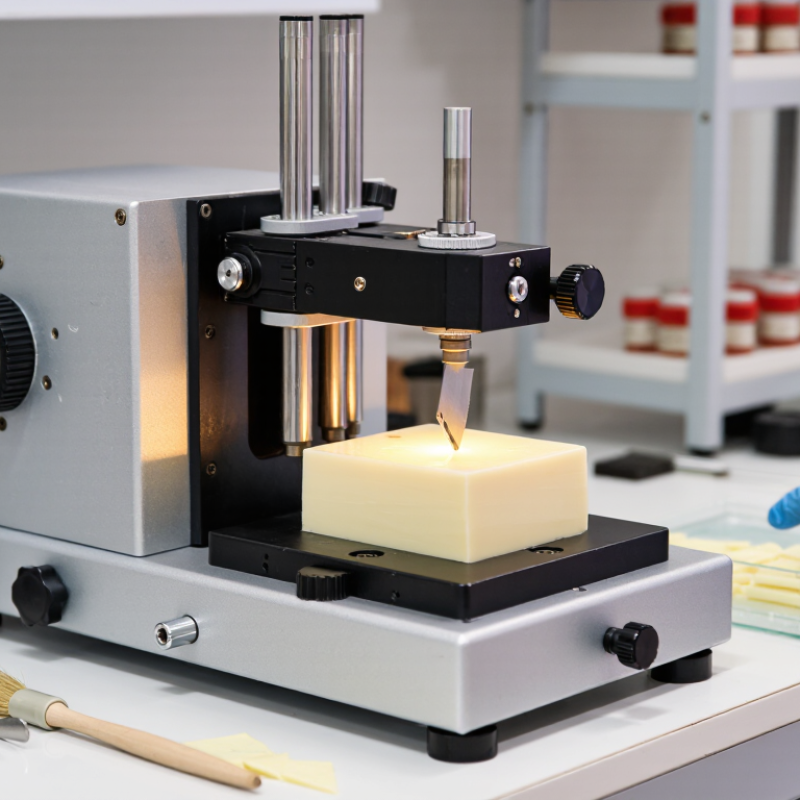
Match the Microtome’s Section-Thickness Range to Routine 3–5 µm Paraffin Cuts
A refurbished microtome may list a wide section-thickness range, but routine paraffin work depends on dependable cuts around 3–5 µm. Check that the instrument can select these settings directly and repeat them reliably. A listed minimum or maximum tells you little about performance in the middle. That distinction matters.
Ask the seller how thickness settings were checked after refurbishment. Look for service records, calibration details, and a recent demonstration using a paraffin block. Watch several consecutive sections at 3–5 µm. Do they form a steady ribbon, or alternate between smooth sections and compressed, torn ones? Some variation can come from the block, blade, or operator, so a single poor cut is not proof of a faulty instrument. Still, repeated inconsistency deserves investigation.
Inspect the feed mechanism and thickness controls for looseness, uneven movement, or settings that drift during cutting. Confirm that the specified range supports the specimens and routine workflow you actually handle. If possible, test with your usual block type and blade setup; a demonstration with different materials may not reflect daily results. Ask what adjustments were needed. Refurbished equipment can be a practical choice, but its stated range is only useful when fine settings remain stable in real work.
| Tip | What to Check | Why It Matters for 3–5 µm Paraffin Sections | Buyer’s Action |
|---|---|---|---|
| 1. Confirm the usable thickness range | Check the instrument’s documented section-thickness range and confirm that both 3 µm and 5 µm settings are available. | A stated minimum or maximum alone does not prove that the instrument can reliably produce the settings used in your routine workflow. | Request the manual or specification sheet; do not rely only on a seller’s general description. |
| 2. Check the adjustment increments | Verify that the thickness control includes clearly marked 3 µm and 5 µm settings, or supports those values through its documented adjustment scale. | A suitable overall range may still be inconvenient if the control cannot be set precisely to the thicknesses your laboratory needs. | Ask for a close-up of the control and have the seller demonstrate selection of both settings. |
| 3. Request a test cut at your routine settings | Ask for a demonstration using a paraffin-embedded tissue block at 3 µm and 5 µm, with an appropriate sharp blade and properly prepared block. | Section quality depends on the complete setup and operating condition, not just the thickness dial or specification range. | Review the resulting ribbons or sections and note the blade, block, and settings used in the demonstration. |
| 4. Inspect feed and thickness-control performance | Check for smooth, repeatable feed movement, secure locking controls, and an undamaged thickness adjustment mechanism. | Wear, looseness, or inconsistent movement can make routine thin-sectioning difficult even when the nominal range includes 3–5 µm. | Have the seller cycle the mechanism and demonstrate repeated cuts at a fixed setting. |
| 5. Verify blade-holder compatibility and condition | Confirm which blade types and holder formats the refurbished unit accepts; inspect the clamp, guards, and adjustment surfaces. | A stable, correctly aligned blade is important for consistent sectioning. Blade and holder compatibility varies by instrument design. | Check the documentation and confirm that compatible blades and replacement parts are available to your facility. |
| 6. Review refurbishment and calibration records | Request a written service history, a list of replaced or repaired parts, and any available thickness-setting verification records. | A specification describes intended capability; service and verification records provide evidence about the condition of the actual used instrument. | Clarify which checks were performed, when they were performed, and whether results are included with the sale. |
| 7. Evaluate support, parts, and return terms | Confirm the availability of technical support, service parts, operating instructions, and a clear inspection or return period. | A used instrument may need adjustment or repair; access to support helps protect routine sectioning work after purchase. | Get the warranty or return conditions in writing and confirm who is responsible for service and shipping costs. |
Note: Routine paraffin section thickness depends on the laboratory protocol and specimen. Verify the specific instrument’s documented settings and performance before purchase.
Related Posts
-

2026 Top Sakura Microtome Types Buying Guide for Global Buyers
-

What Is the Best Thermo Fisher Microtome?
-

What is the Best Thermo Microtome for Precision Cutting?
-
10 Best Thermo Microtomes for Global Buyers?
-

Best Microm Microtome Techniques for Precision Cutting?
-

2026 Best Hm 325 Microtome Features and Benefits Explained?
